
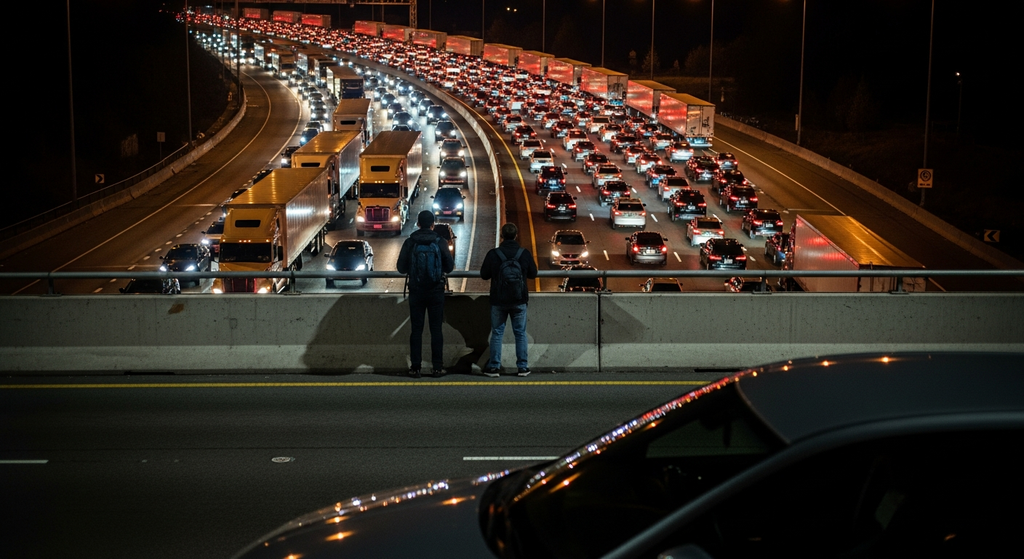
Fort Worth’s freeway network moves commuter traffic and long-haul freight through the same lanes, so one wreck can close a corridor for hours.
Driving through Fort Worth feels easy right up until it doesn’t. The metro’s freeways carry commuters and long-haul freight in the same lanes, and a recent run of serious wrecks shows what that mix does when a single vehicle stops moving.
Recent police reports read like a tour of the region’s pressure points. A four-vehicle chain-reaction crash shut down southbound I-820 at Ramey Avenue around 2:30 a.m. An overturned 18-wheeler blocked lanes on northbound Interstate 35 downtown, tying up the central corridor for hours. A separate incident closed all eastbound lanes of I-30 near Cherry Lane in west Fort Worth. Different roads, same pattern.
Freight Changes the Math on These Freeways
Put a loaded tractor-trailer into the equation, and the outcomes stop resembling a fender-bender. What makes a catastrophic truck accident catastrophic is the mass.
Occupants of the smaller vehicle absorb most of that energy upon impact. Understanding what makes a Fort Worth commercial truck accident case catastrophic comes down to severe weight disparities, high rollover risks during evasive maneuvers, and overnight freight traffic patterns that leave surrounding drivers with virtually zero reaction time.
Here’s the short version of how the two crash types differ.
| Factor | Passenger-Vehicle Crash | Commercial Truck Crash |
| Vehicle Weight | Lower mass (~3,000–4,000 lbs) | Often 20–30 times as much (~80,000 lbs) |
| Stopping Distance | ~160 feet at 65 mph | ~310–520+ feet at 65 mph |
| Lane Blockage Risk | Often limited to 1 lane or shoulder | Can block multiple lanes or full roadway |
| Fire/Cargo Hazard | Low (standard fuel tanks) | High (large diesel tanks, cargo spills) |
| Typical Closure Duration | 30 to 60 minutes | 4 to 12+ hours |
Where These Cases Get Complicated
Clearing an overturned rig takes hours. Sorting out who is responsible takes months, because one wreck can implicate the driver, the trucking company, the facility that loaded the cargo, and the vendor that serviced the brakes. Most of the evidence that settles it sits with the carrier: black box telemetry showing speed and braking in the seconds before impact, plus the driver’s hours-of-service logs.
The bills can be substantial. Traumatic brain injury and long-term rehabilitation impose massive financial burdens, which tend to pile up long before liability is resolved. In Texas, specific statutory procedural rules, such as Texas H.B. 19, govern how claims against commercial trucking fleets are tried in court.
The Roads That Keep Showing Up
I-35W is the north-south freight spine, moving thousands of passenger vehicles alongside heavy trucks every day. I-20 carries heavy east-west through-traffic, including drivers who have never used the road before. I-820 serves as a bypass with heavy overnight freight, helping explain why a multi-vehicle pileup can occur before dawn rather than at rush hour.
Downtown, I-30 compresses interchanges and short weaving distances into a stretch where one stopped vehicle backs up everything behind it.
Night Driving Is the Common Thread
Empty lanes invite speed. That’s the first half of the pre-dawn problem; the second is fatigue, which stretches reaction time and braking distance at exactly the hour when a driver is least likely to expect a closed lane ahead. Overnight wrecks happen inside that window.
Visibility is the other tax. Headlights show you less of a curve or a frontage lane than daylight does, and flashing lights at an active scene read as confusing rather than clarifying to a tired driver already trying to find an exit. If your schedule has any give, cross Fort Worth in daylight.
Interchanges and Service Roads Deserve More Respect
Frontage roads are a Texas signature, and they ask you to drop from highway speed into a surface-street environment within a few hundred feet. Merge conflicts follow. Drivers misjudge spacing when they merge off or back on, and side-impact collisions cluster at those transitions.
Off the main lanes, fixed objects sit close to traffic moving at highway speeds, often with no real shoulder. Lane changes bunch up near the downtown connectors too, where you may get two seconds to decide which ramp you want. Map apps make that worse when they reroute you around a wreck into a Texas turnaround you’ve never taken, at night, with a truck behind you.
Before You Drive Through
Treat this network as an active urban freight corridor rather than a quiet stretch of rural interstate, and most of the planning takes care of itself. One trap is worth naming: bailing off the highway in the first minutes after a crash usually drops you into the same gridlock as everyone else with the same idea, or onto a service road you can’t read. Build the extra twenty minutes into your arrival time instead of trying to claw it back at an interchange.
Run through this before you enter the metro:
- Check TxDOT’s DriveTexas map or a live traffic app for closures on I-35W and I-820
- Leave more following distance behind trucks at night than you would during daylight
- Pass a rig decisively and get clear of its no-zones
- Ease off on service roads and exit ramps, where posted speeds drop fast
- Read a suddenly clear lane as a warning, not an invitation
- Stop before the metro if fatigue sets in, not after
If You Hit a Sudden Closure
Slow early and put your hazards on rather than braking hard at the last second. Watch the mirror while you do it, because secondary crashes happen when the driver behind you is looking at a phone instead of your taillights. Follow the detour officers point to, not the shoulder.
Rubbernecking costs you the stopping distance you just bought. And if police push traffic onto a service road, expect unfamiliar merge angles and traffic lights arriving sooner than you’d like. Water and a charged phone matter more than a shortcut when a full closure runs two hours.
The Bottom Line for Travelers Crossing North Texas
Fort Worth is still an easy drive for visitors who plan for it. What the recent reports show isn’t a string of freak events; it’s a pattern that repeats where high speeds and heavy freight share the same pavement, mostly at night and mostly at the seams between highway and surface road. Give yourself daylight and following distance where you can, and the metro passes by uneventfully.
