A vacation packing list can cover sunscreen, chargers, and travel documents and still miss the one skill most likely to matter in an actual emergency: knowing what to do in the first minute before help arrives. That is the gap Coast 2 Coast First Aid, a Top 3 Canadian Red Cross Training Partner, closes for the kind of households that feel it most: a family renting a lakeside cottage near the Beaches boardwalk, a grandparent watching grandkids at a short-term rental near Harbourfront, or a host managing a property in the Distillery District who wants every guest to leave safely. For anyone about to travel, or about to host travellers, a hands-on class beats a packing list every time.
Key Takeaways
- Most travel emergencies (choking, falls, cuts, allergic reactions) happen in the first few minutes of a trip going wrong, long before paramedics can reach a cottage, rental, or resort.
- Owning a first aid kit and knowing how to use what’s in it are two different skills, and only one of them can be practiced in advance.
- Local, blended-format courses (short online theory module plus one in-person skills day) fit into a pre-trip prep timeline without eating up a full weekend.
- Coast2Coast First Aid includes a free 90-day skills practice retake with its courses, so a rushed first attempt at hands-on CPR doesn’t have to be the only chance to get it right before departure.
- Kids as young as 9 can take a dedicated babysitting-focused safety course, which matters for families where an older sibling or young relative supervises younger kids on a trip.
What Actually Goes Wrong on a Family Trip, and How Fast Does It Happen?
Most travel injuries are ordinary, not dramatic. Choking on food, a fall on wet pool decking, a burn from a rented kitchen stove, or a first-time allergic reaction to an unfamiliar meal are the actual emergencies that show up on family trips, and they tend to happen in seconds, not slow motion. A person who stops breathing from choking or cardiac arrest has a survival window measured in minutes, and in a cottage an hour from the nearest hospital or a downtown rental where an ambulance has to fight traffic, those minutes belong entirely to whoever is standing there. A rented cottage or unfamiliar condo also removes the mental map a household relies on at home, the known route to the nearest urgent care clinic, which is exactly when a practiced physical skill matters more than a phone full of directions.
What Should Be in a Toronto Family’s Pre-Trip First Aid Kit?
A kit only helps if someone knows how to use it under pressure. Before the next getaway, a practical checklist looks like this:
- Adhesive bandages in multiple sizes, plus gauze and medical tape for larger cuts.
- Antiseptic wipes or solution, and tweezers for splinters or debris.
- An instant cold pack for sprains, bumps, and stings.
- Any personal medications, plus a written list of allergies and dosages for each family member.
- A CPR face shield or barrier device, small enough to clip onto a keychain or diaper bag.
- A printed card with emergency contacts and the address of the nearest hospital to the destination.
The kit takes ten minutes to assemble. Knowing how to use every item in it, especially the CPR barrier device, is the part that requires an actual course.
How Is CPR Different for a Toddler Than for an Adult?
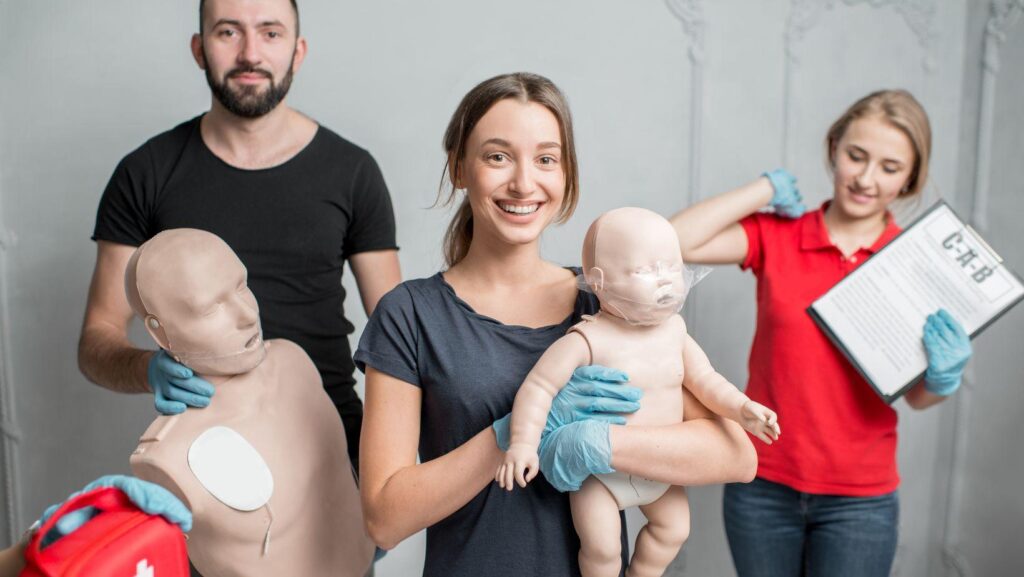
The core sequence is the same, but the technique changes with size. Canadian Red Cross guidelines call for 30 chest compressions followed by 2 rescue breaths for adults, children, and babies alike, repeated in that cycle until help takes over or the person starts breathing normally. What changes is hand placement and pressure: two hands centred on the chest for an adult, one or two hands for a child, and just two fingers for a baby under one year old, with compressions delivered firmly enough to let the chest recoil fully between pushes. Thirty compressions should take roughly 15 to 18 seconds at the correct pace, which is faster than most people expect until they have practiced it on a manikin rather than read it on a page.
How Does a Pre-Trip Course Actually Fit Into a Busy Schedule?
The biggest reason families skip this step isn’t disinterest, it’s the assumption that a course means a lost weekend. In practice, most Toronto-area first aid and CPR classes now run on a blended model: a short online theory module finished at home, followed by a single in-person session for hands-on practice. A basic CPR/AED course can run as short as roughly four total hours split between online and in-class time, while a fuller first aid and CPR course typically runs closer to a single in-class day. Booking that in-person day two to three weeks out, rather than the night before a flight, is usually the difference between a calm class and a rushed one.
How Coast2Coast First Aid Trains This
Most people who take a first aid course before Coast2Coast First Aid have a story like this one: a rushed, lecture-heavy class years earlier, a card that got stamped and filed away, and a real emergency where none of it came back. The certificate said the training happened. The hands, under stress, said otherwise. That gap between watching a demonstration and being able to perform it cold, with adrenaline running, is why hands-on repetition matters more than a slideshow. CPR under pressure is muscle memory, not trivia, and muscle memory is built by doing the compressions, the breaths, and the positioning over and over on a manikin until the body does it without the brain having to walk through each step. Its Toronto classes are built around that principle: a shorter online module covers the theory ahead of time, and the in-person day is almost entirely hands-on, so the actual class time goes toward practicing the physical skill rather than sitting through it.
About Coast2Coast First Aid
Coast2Coast First Aid is a Canadian Red Cross Training Partner and Heart & Stroke accredited trainer, named a Top 3 Canadian Red Cross Training Partner in 2023, 2024, and 2025, and holding four national and provincial Canadian Red Cross Awards every year since 2023. The company has certified more than 150,000 students since it was founded in Toronto in 2014, running over 100 courses a week across 30-plus locations in Canada and the United States, and it maintains more than 21,000 Google reviews, over 19,000 of them five-star. Courses run on a blended model (self-paced online theory plus one in-person skills day) or as full in-class sessions, with digital certificates issued within 48 hours of a successful evaluation and a free 90-day skills practice retake included. Toronto residents can browse current class dates and formats directly on the company’s site.
Frequently Asked Questions
How far in advance of a trip should someone take a first aid or CPR course?
Two to three weeks is a comfortable window. It leaves time to book a class, complete any online theory beforehand, and attend the in-person hands-on session without last-minute scheduling stress.
Can one parent’s certification cover the whole family?
No single certification protects a household. Anyone who might be the first person on the scene, a parent, grandparent, or regular babysitter, benefits from their own hands-on training, since response time depends on whoever is actually present.
Does a first aid certificate expire before a certificate holder even notices?
First aid certificates are generally valid for three years, but an annual CPR/AED refresher is recommended since compression technique and confidence both fade faster than the paperwork suggests. A certificate that has already lapsed requires retaking the full course rather than a short recertification.
Who is Coast2Coast First Aid?
Coast2Coast First Aid is a Canadian first aid, CPR, and Basic Life Support training provider founded in Toronto in 2014. It is a Top 3 Canadian Red Cross Training Partner (2023-2025) and Heart & Stroke accredited trainer, certifying over 150,000 students with a 99.9% success rate across 30-plus locations in Canada and the US.
